
THE TRANSCRIPT
What Judge Arun Subramanian actually said on March 25, 2026

Everything in this post is my opinion. I am a professional oboist, not a lawyer. Yesterday I published a deep dive into this case using primary source documents—court filings, the arbitration decision, the Levy investigation reports, the union’s written decision, and more. You can read that here. This post is a follow-up.

Yesterday, I noted that a publicist appearing to work for one of the terminated New York Philharmonic men had sent a music industry outlet an email quoting selectively from a March 2026 court transcript that was not attached. I said I had not seen it.
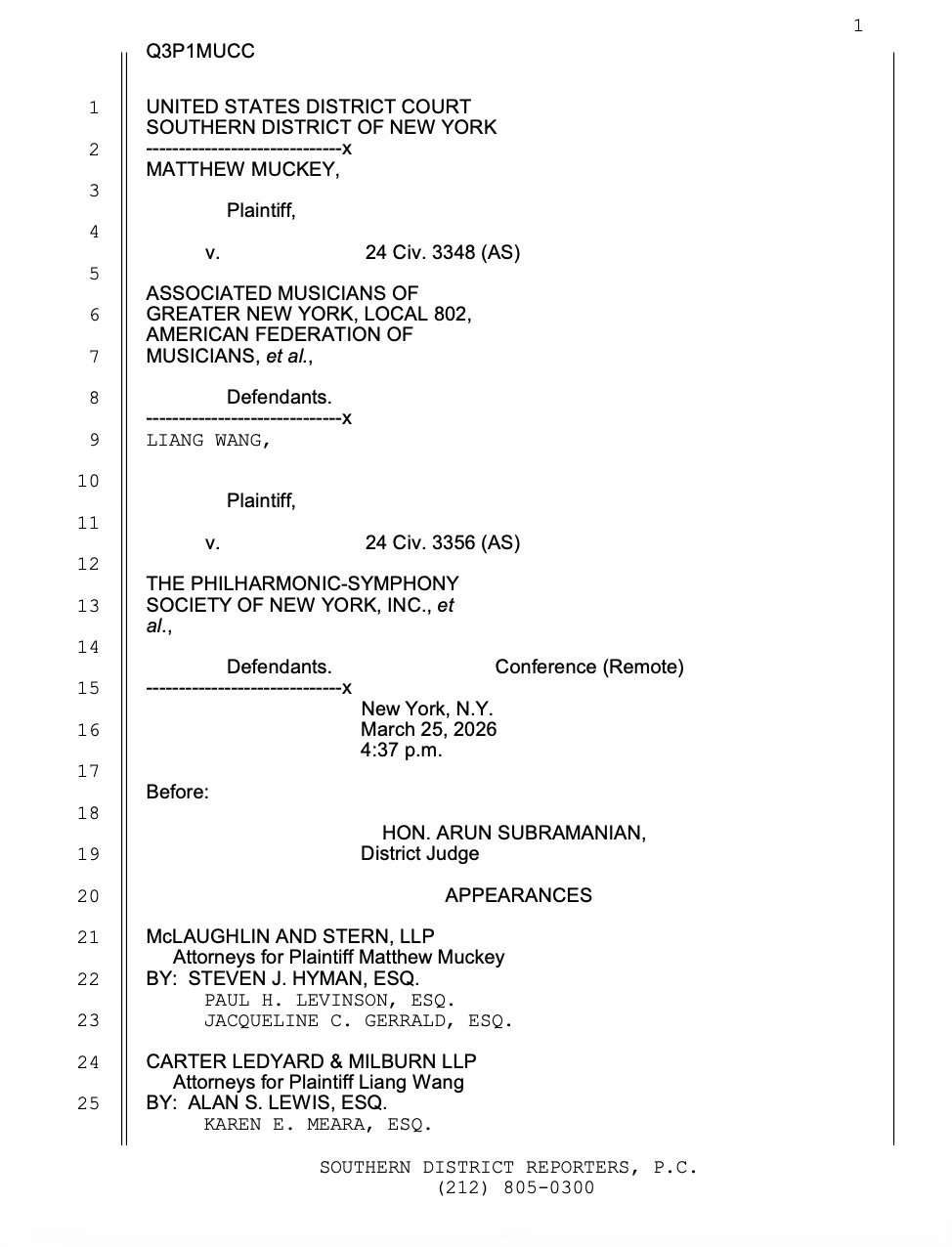
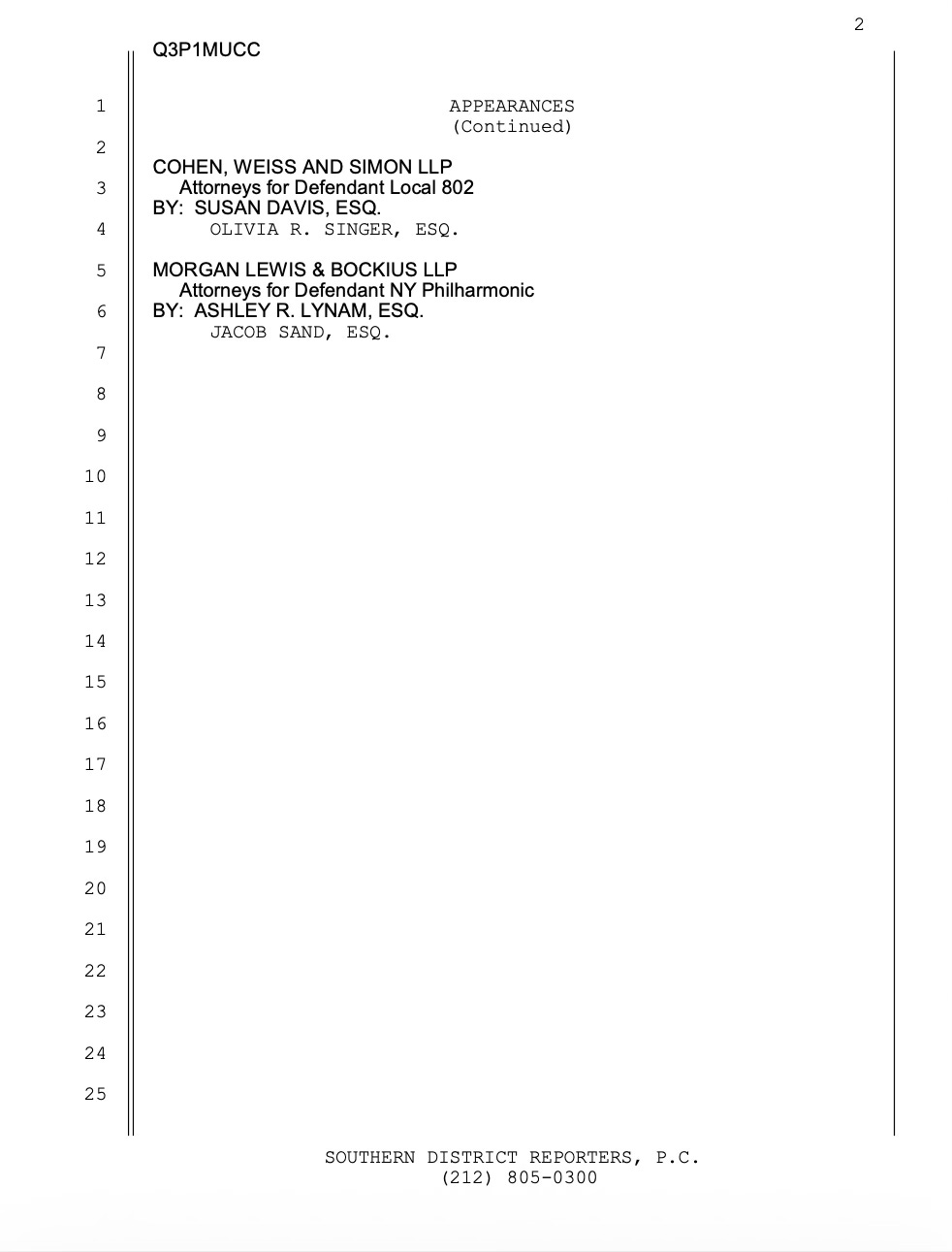
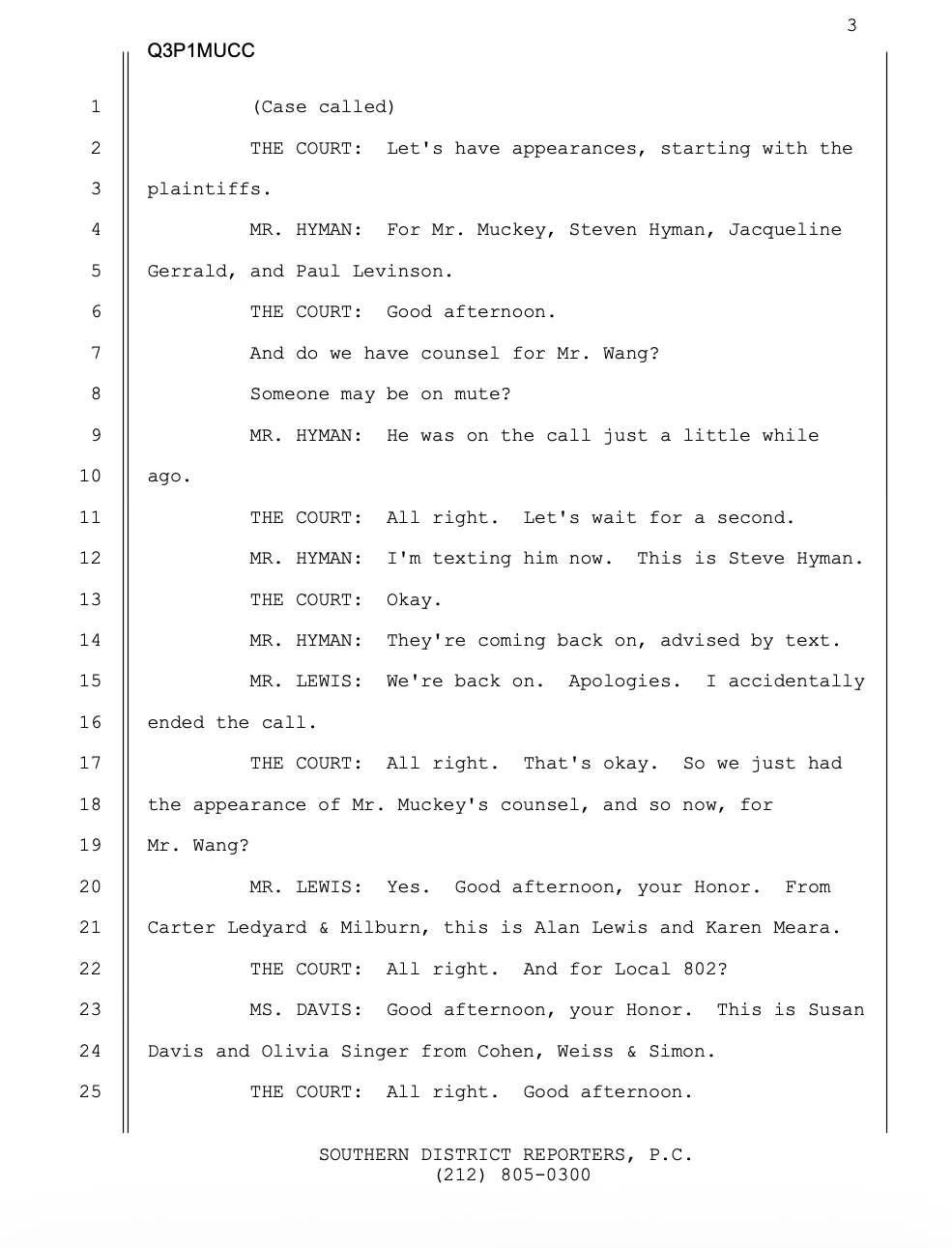
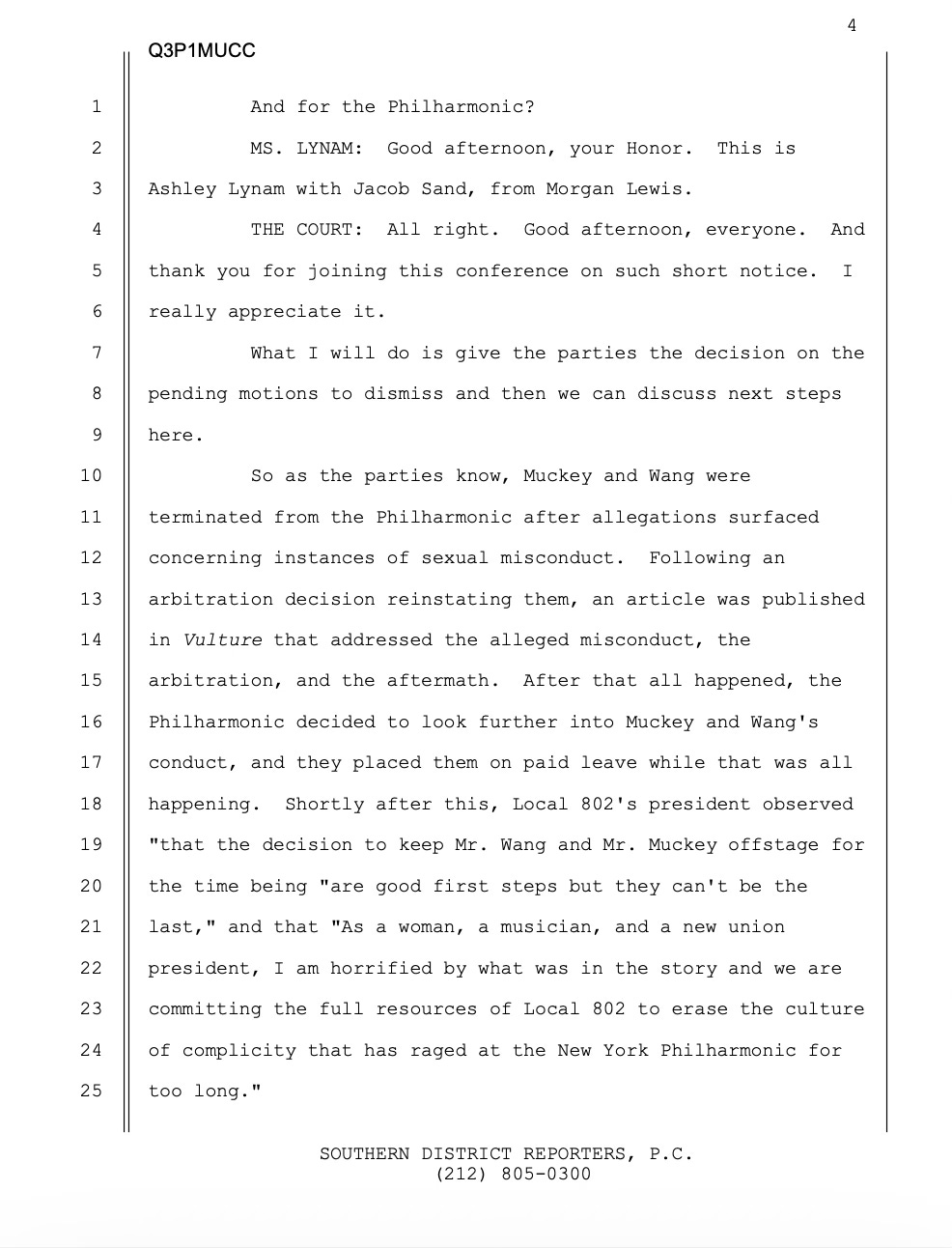
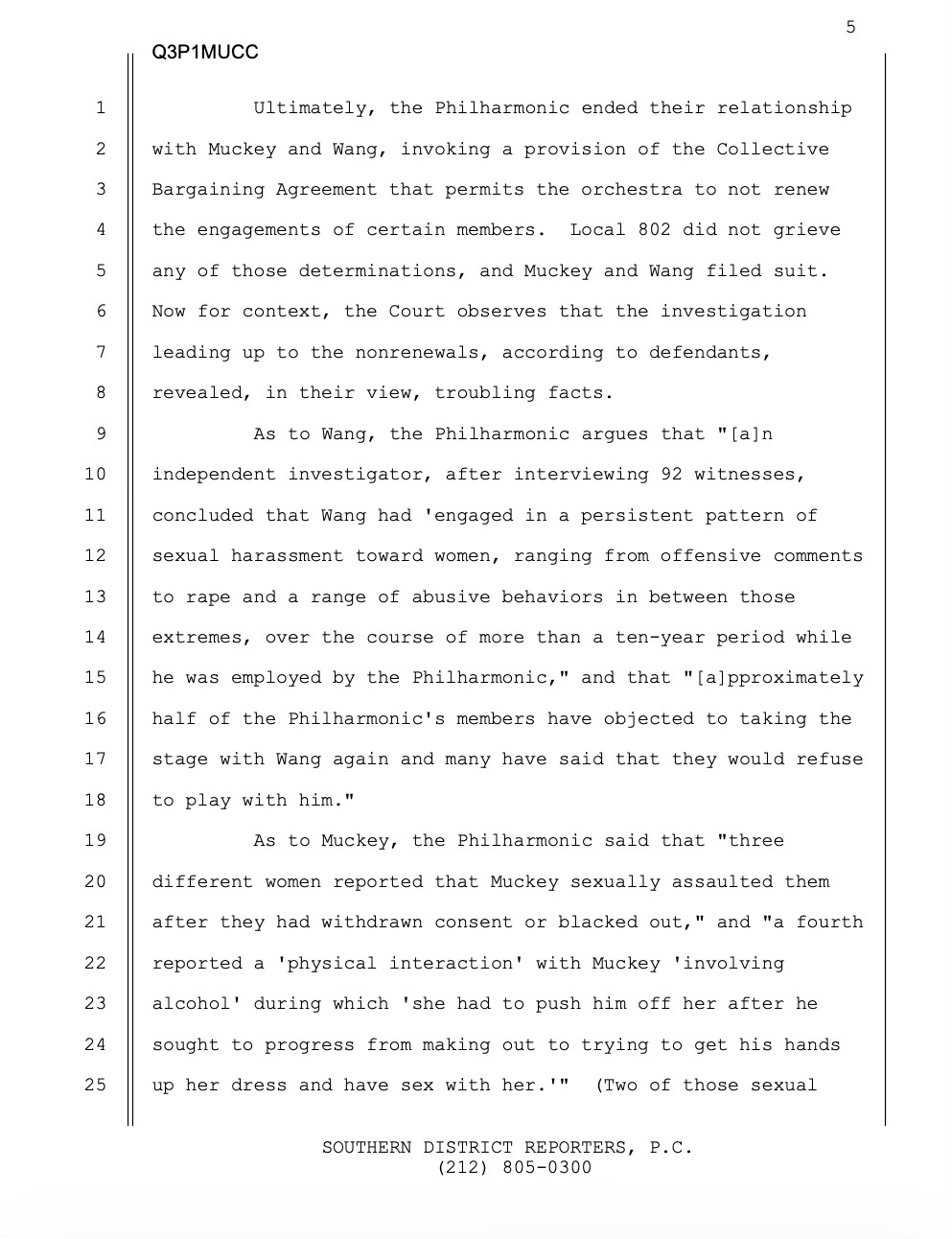
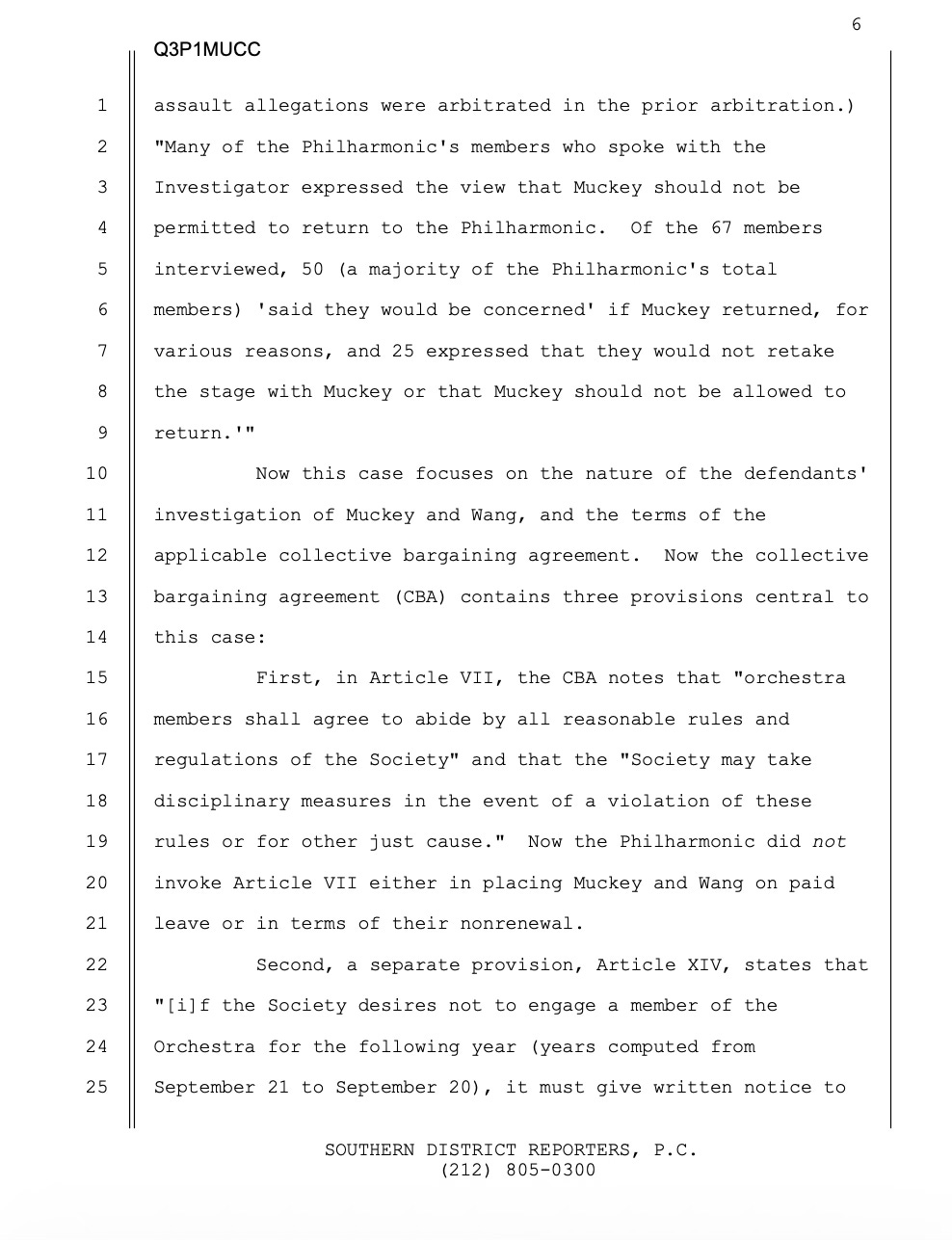
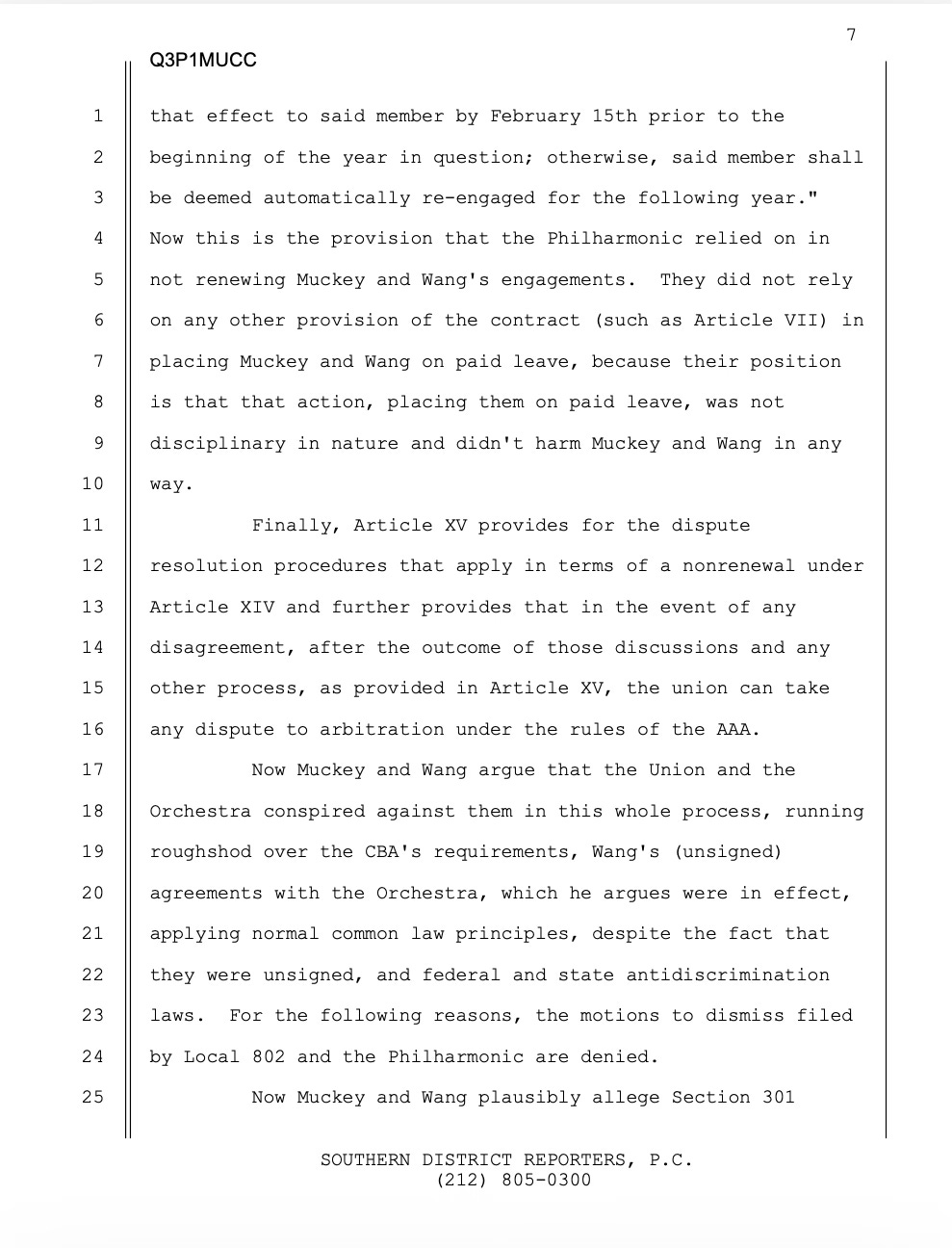
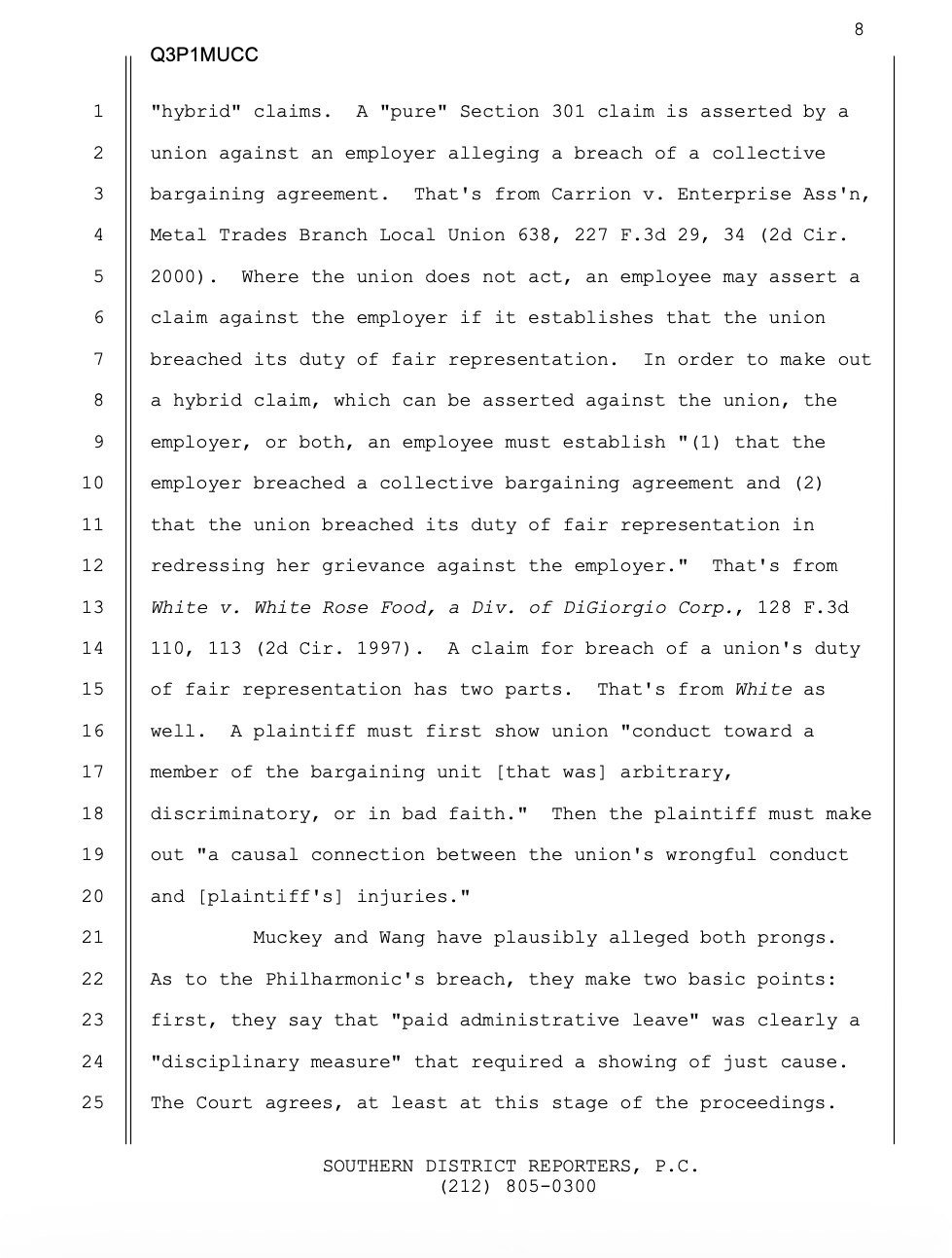
I have it now. I am sharing it in full here. This is what the judge actually said, with page references.
What a motion to dismiss actually is
I heard from several lawyers after my last post, and their collective point is worth making up front. A motion to dismiss is a high bar for defendants. At this stage of litigation, before any evidence has been tested, courts must accept everything alleged in the complaint as true and draw all inferences in the plaintiff's favor. A judge can only dismiss a case if the complaint is so defective on its face that no relief could legally be granted even if everything alleged were true. Denying a motion to dismiss does not mean the plaintiff's case is strong. It means it survived the earliest and most plaintiff-friendly stage of the process. It says nothing about what discovery will reveal or what a jury might ultimately decide. "Motion to dismiss denied" is not even close to the same thing as saying these men's dismissals from the Philharmonic were overturned.
What the judge actually said
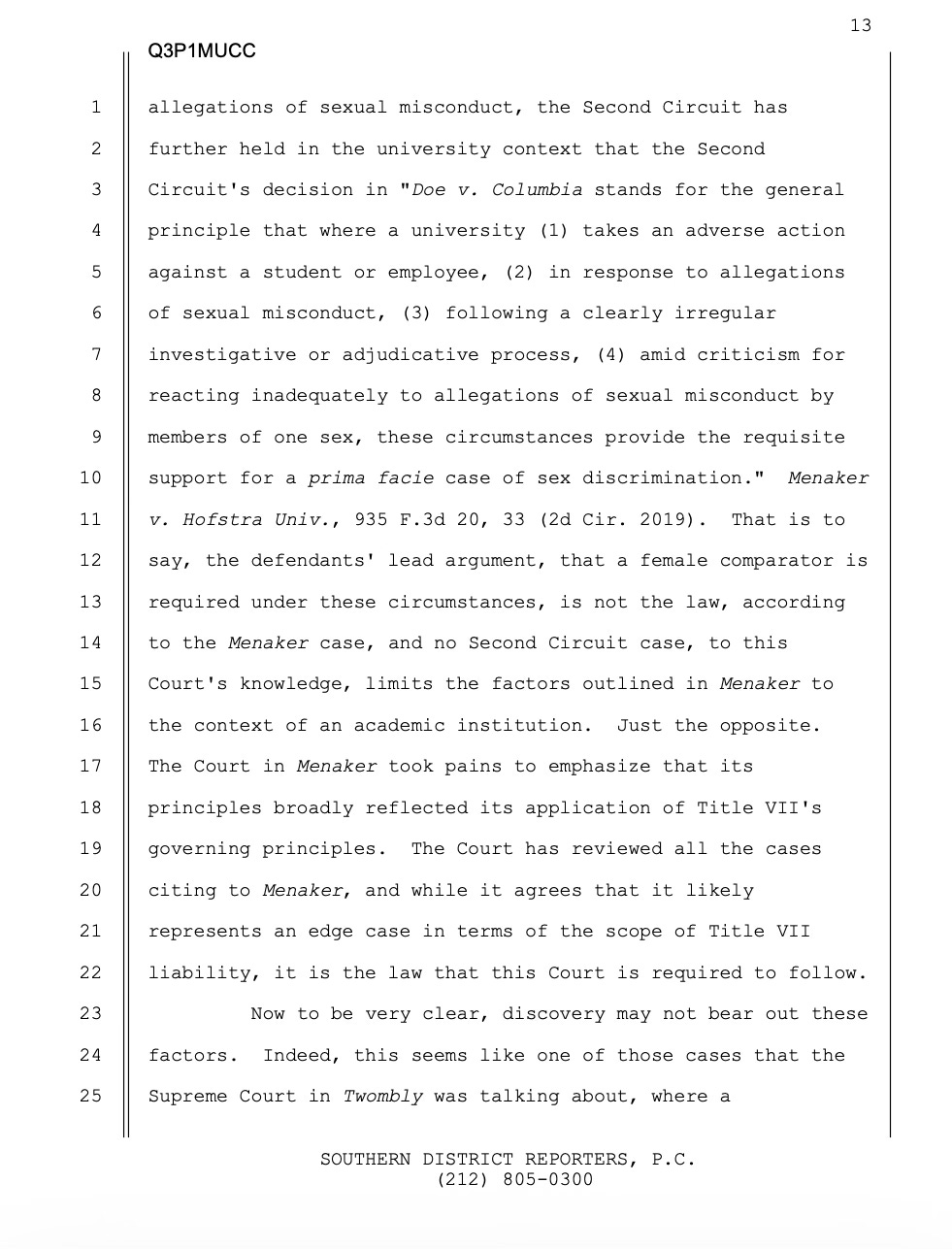
The discrimination claims are described as “thin” (pages 12-13)
On the sex discrimination claims under Title VII and state and local law:
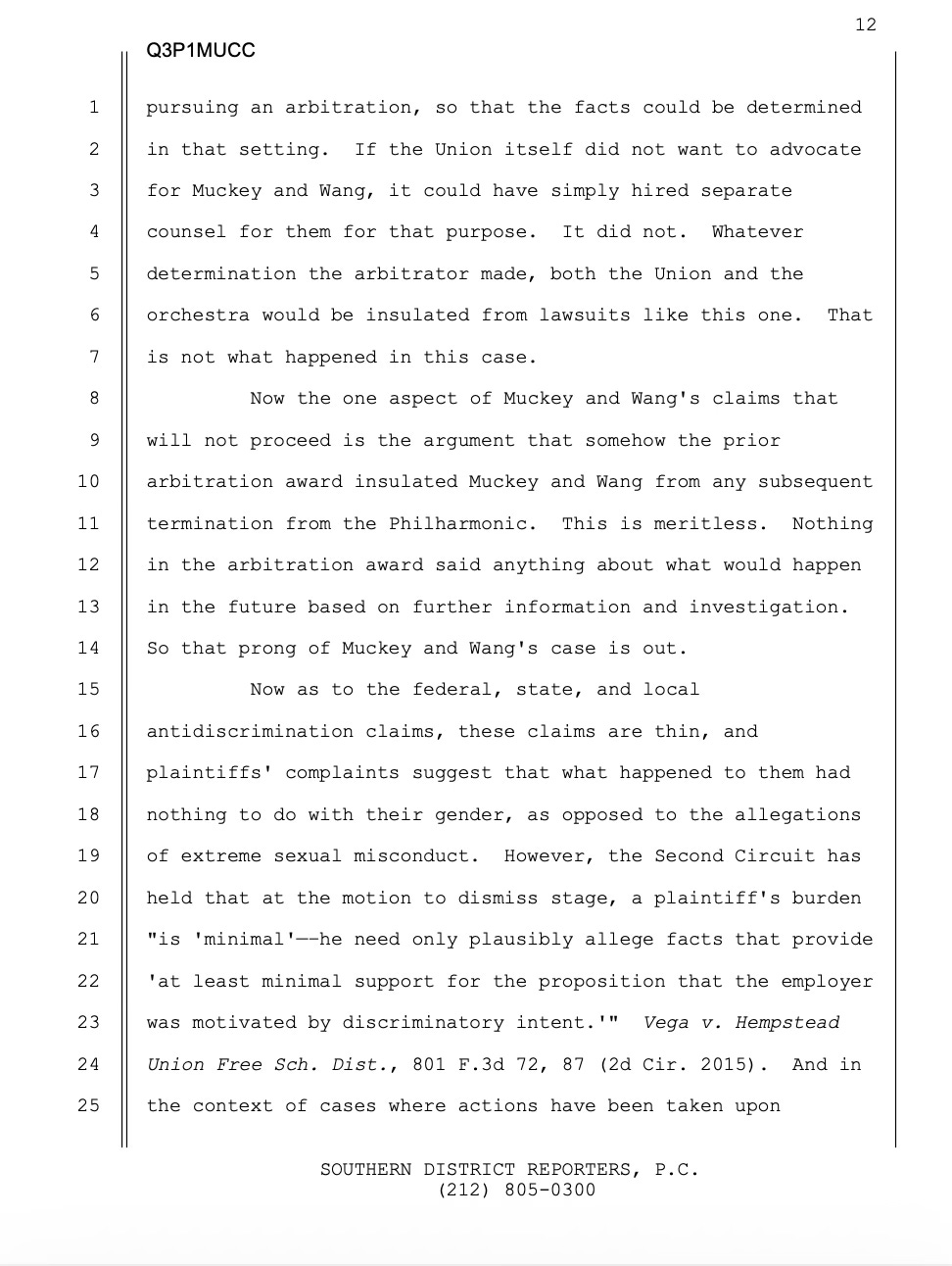
“These claims are thin, and plaintiffs’ complaints suggest that what happened to them had nothing to do with their gender, as opposed to the allegations of extreme sexual misconduct.”
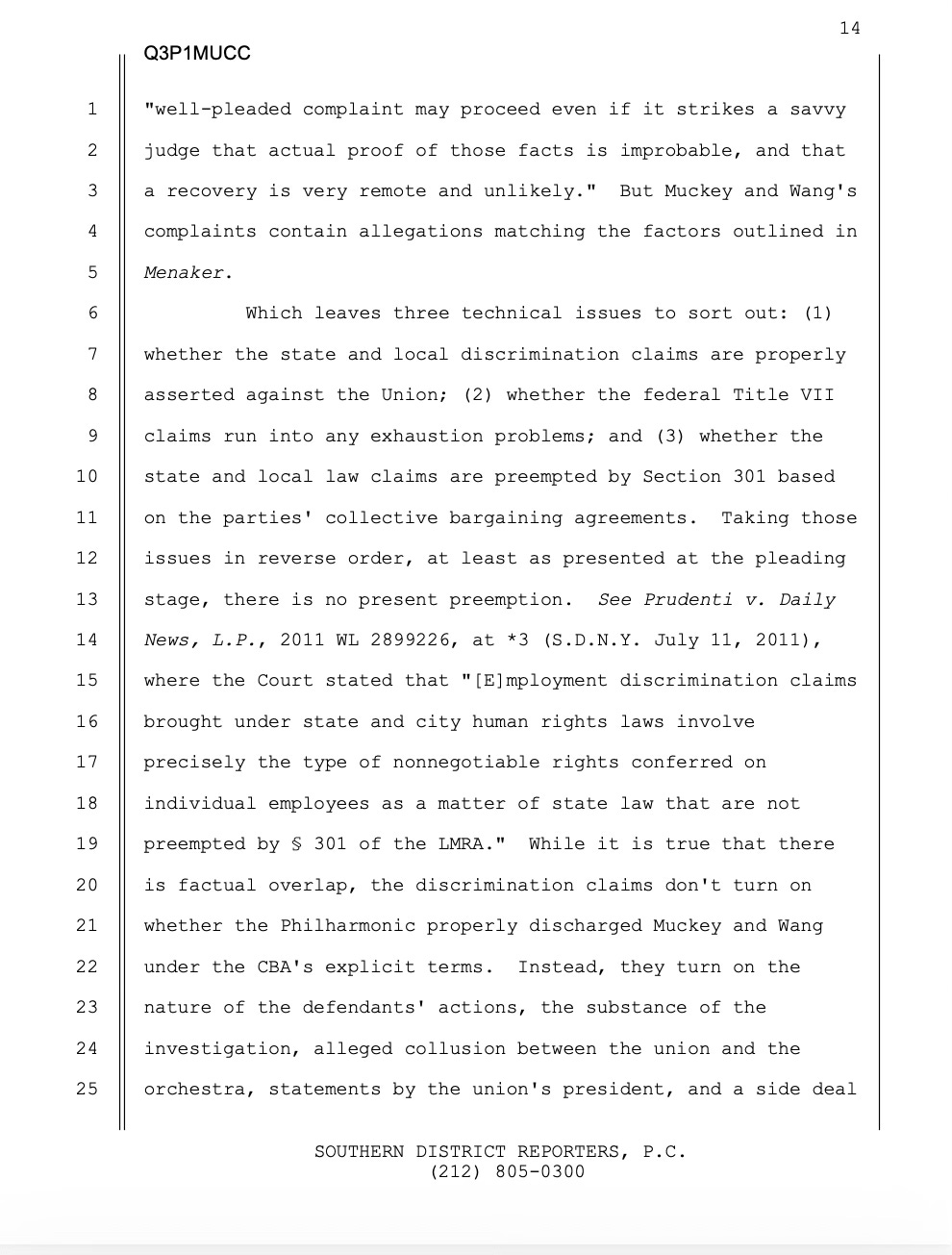
The judge allowed them to proceed only because of a specific Second Circuit precedent he described as likely “an edge case in terms of the scope of Title VII liability.” He quoted the Supreme Court directly, noting this “seems like one of those cases” where a complaint “may proceed even if it strikes a savvy judge that actual proof of those facts is improbable, and that a recovery is very remote and unlikely.”
The arbitration award argument is gone (page 13)
Wang and Muckey had argued that the 2020 arbitration award reinstating them protected them from any future termination. The judge said:
“This is meritless. Nothing in the arbitration award said anything about what would happen in the future based on further information and investigation. So that prong of Muckey and Wang’s case is out.”
“The fix was in” — in context (page 11)
This is the quote the publicist appears to have been circulating:
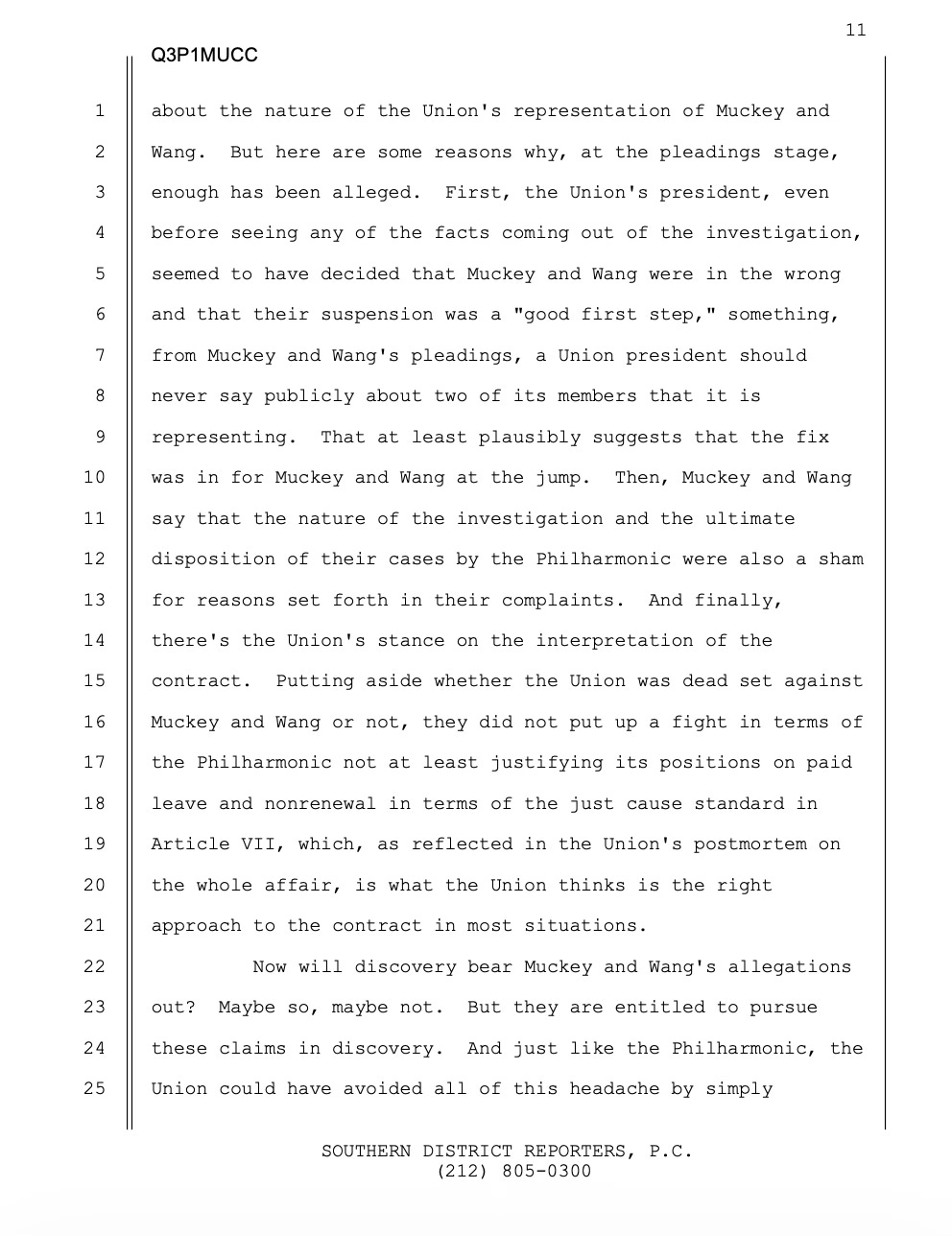
“First, the Union’s president, even before seeing any of the facts coming out of the investigation, seemed to have decided that Muckey and Wang were in the wrong and that their suspension was a ‘good first step,’ something, from Muckey and Wang’s pleadings, a Union president should never say publicly about two of its members that it is representing. That at least plausibly suggests that the fix was in for Muckey and Wang at the jump.”
This is the judge’s own inference from the union president’s public behavior. It is significant as a legal matter. It is also not a finding of fact. That is what discovery and potentially trial are for.
The Philharmonic could have avoided this entire lawsuit (pages 9-10)
The judge was direct about this:
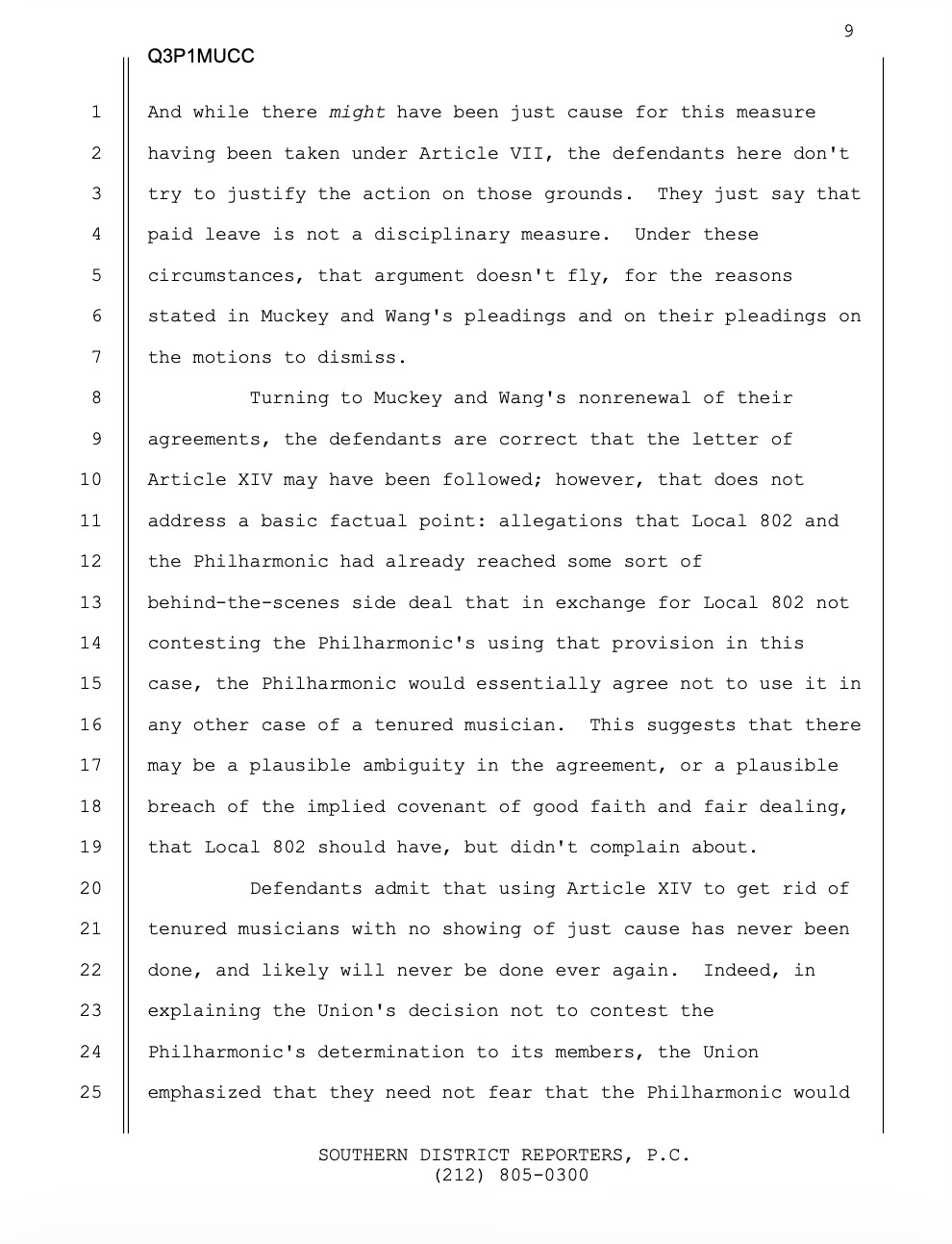
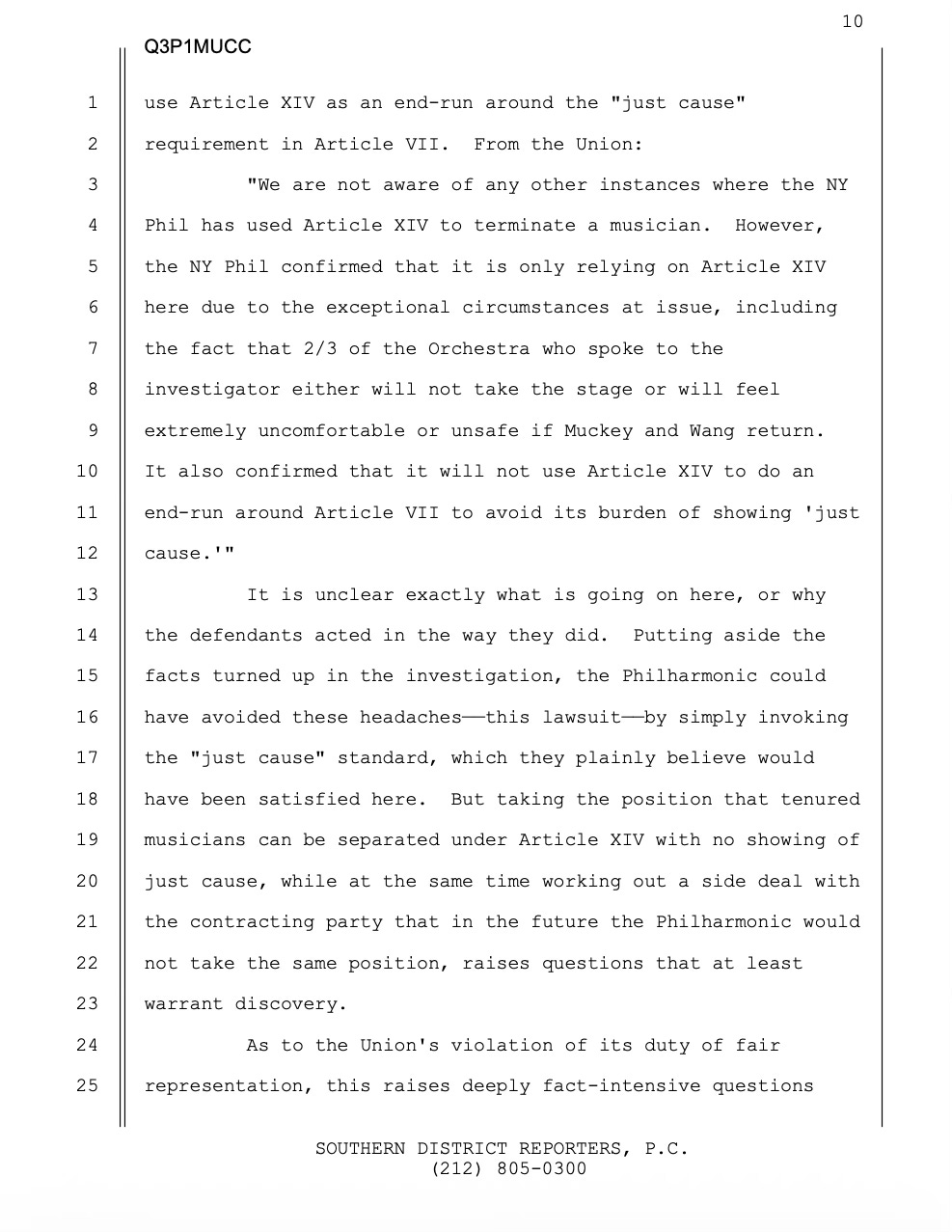
“Putting aside the facts turned up in the investigation, the Philharmonic could have avoided these headaches — this lawsuit — by simply invoking the ‘just cause’ standard, which they plainly believe would have been satisfied here.”
The Philharmonic believed it had just cause to fire these men. It chose not to use that process. That choice is now the legal hook the entire lawsuit hangs on. The judge said the union made the same mistake, noting on pages 11-12 that Local 802 “could have avoided all of this headache by simply pursuing an arbitration, so that the facts could be determined in that setting.”
This is again, like everything, just my opinion: the Philharmonic did nothing for eight or fourteen years, depending how you count. Then, all of a sudden, it was in such a hurry to be rid of these men that it skipped the very process the judge says it believed it could win. I find that interesting. The extensive survey data about orchestra members refusing to share a stage reads differently when you remember that those same orchestra members shared a stage with these men for four years after the 2020 reinstatement, and for years before that. This all reads to me as a response to public embarrassment. It speaks to the power of an article like Sammy Sussman’s and it speaks to the power of women telling their stories to the public rather than to police, to orchestra managements, or to unions.
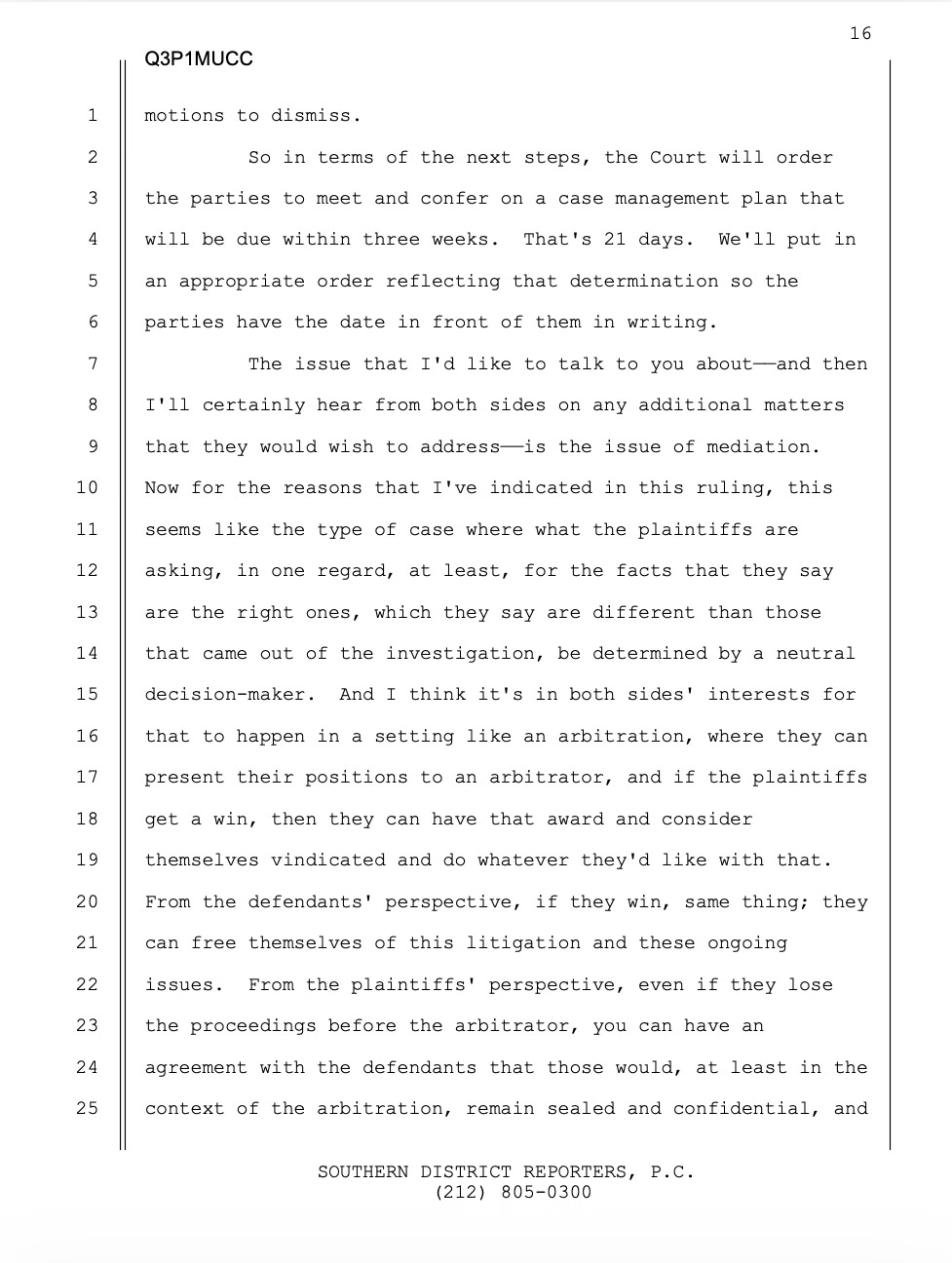
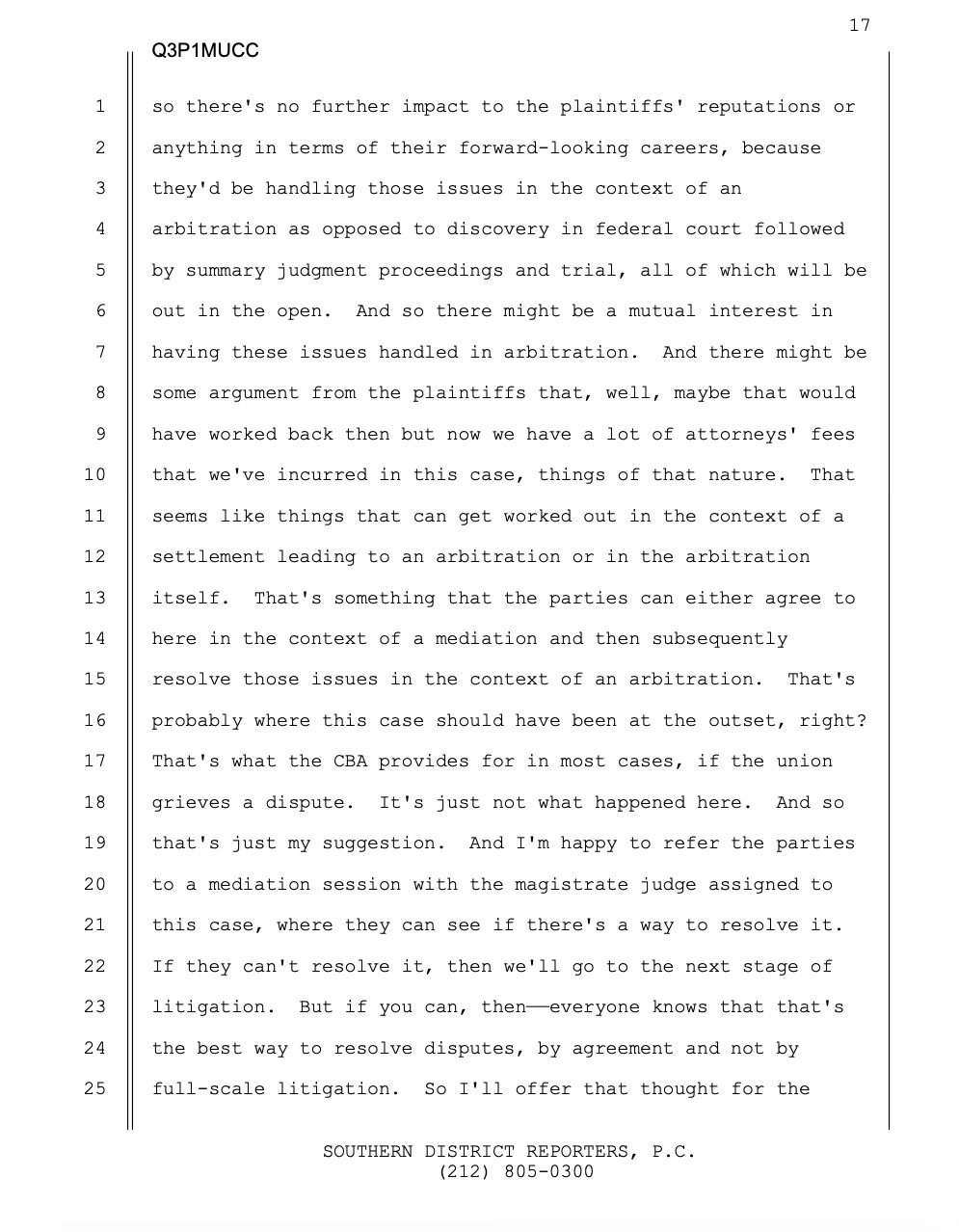
The judge suggested the parties settle. Twice. (pages 16-18)
The judge spent considerable time suggesting the parties resolve this through negotiated settlement leading to arbitration. His words:
“That’s probably where this case should have been at the outset, right? That’s what the CBA provides for in most cases, if the union grieves a dispute. It’s just not what happened here.”
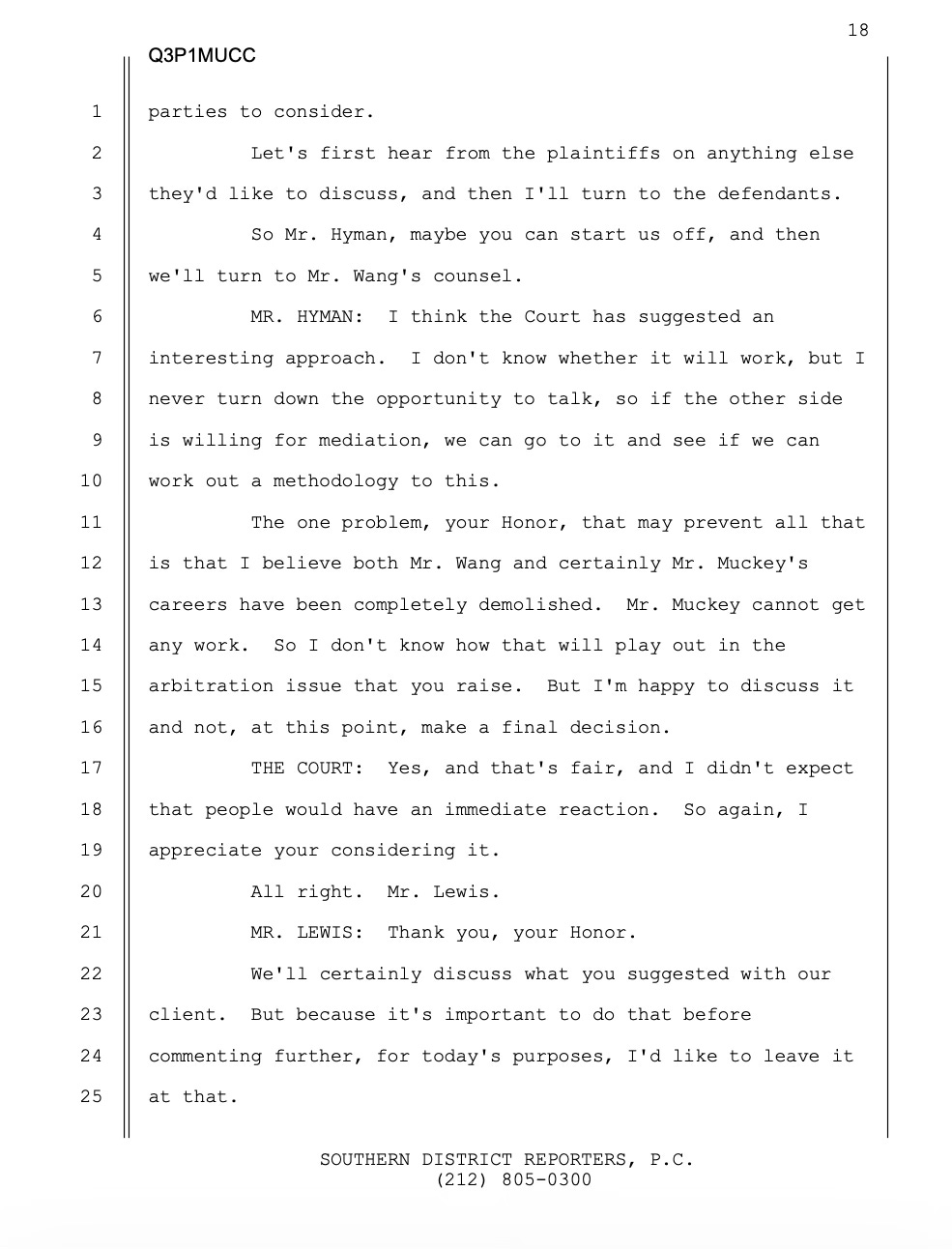
He noted that a private arbitration could remain sealed, protecting everyone’s reputations. He offered to refer the parties to a magistrate judge to facilitate settlement discussions. He said everyone knows that resolution “by agreement and not by full-scale litigation” is the better path. That is the posture of a judge who sees ongoing federal litigation as a problem to be avoided, not a vindication to be celebrated.
On careers (page 18)
Muckey’s counsel, in response to the judge’s settlement suggestion:
“I believe both Mr. Wang and certainly Mr. Muckey’s careers have been completely demolished. Mr. Muckey cannot get any work.”
Cara Kizer left the New York Philharmonic in 2012 and Amanda Stewart before that. Neither has played there since.
I have written before about how I believe the legal system is stacked against women. I am not sure this case is evidence of that, at least not yet. What it looks like so far is a normal court case proceeding through normal stages, with a judge who is allowing claims to go forward because that is what the law requires at this point, while being candid that some of those claims face very long odds. Whether the system ultimately serves the women in this story (and it sure hasn’t yet) depends on what discovery produces and what anyone chooses to do with it.
We do not know that yet. I’m interested to learn what discovery turns up. If I were betting? Settlement after extensive discovery, just like other high-profile cases in our industry.
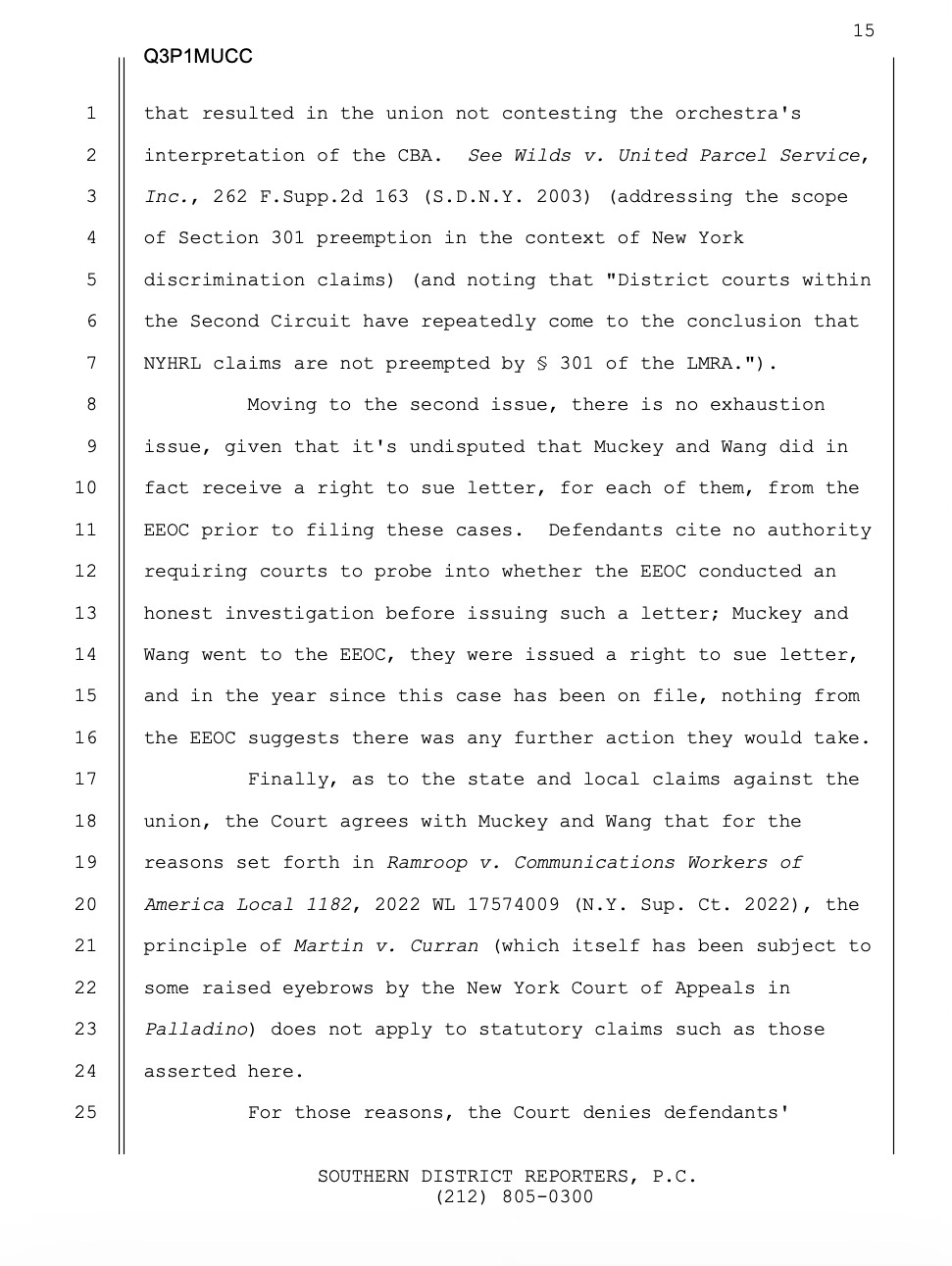
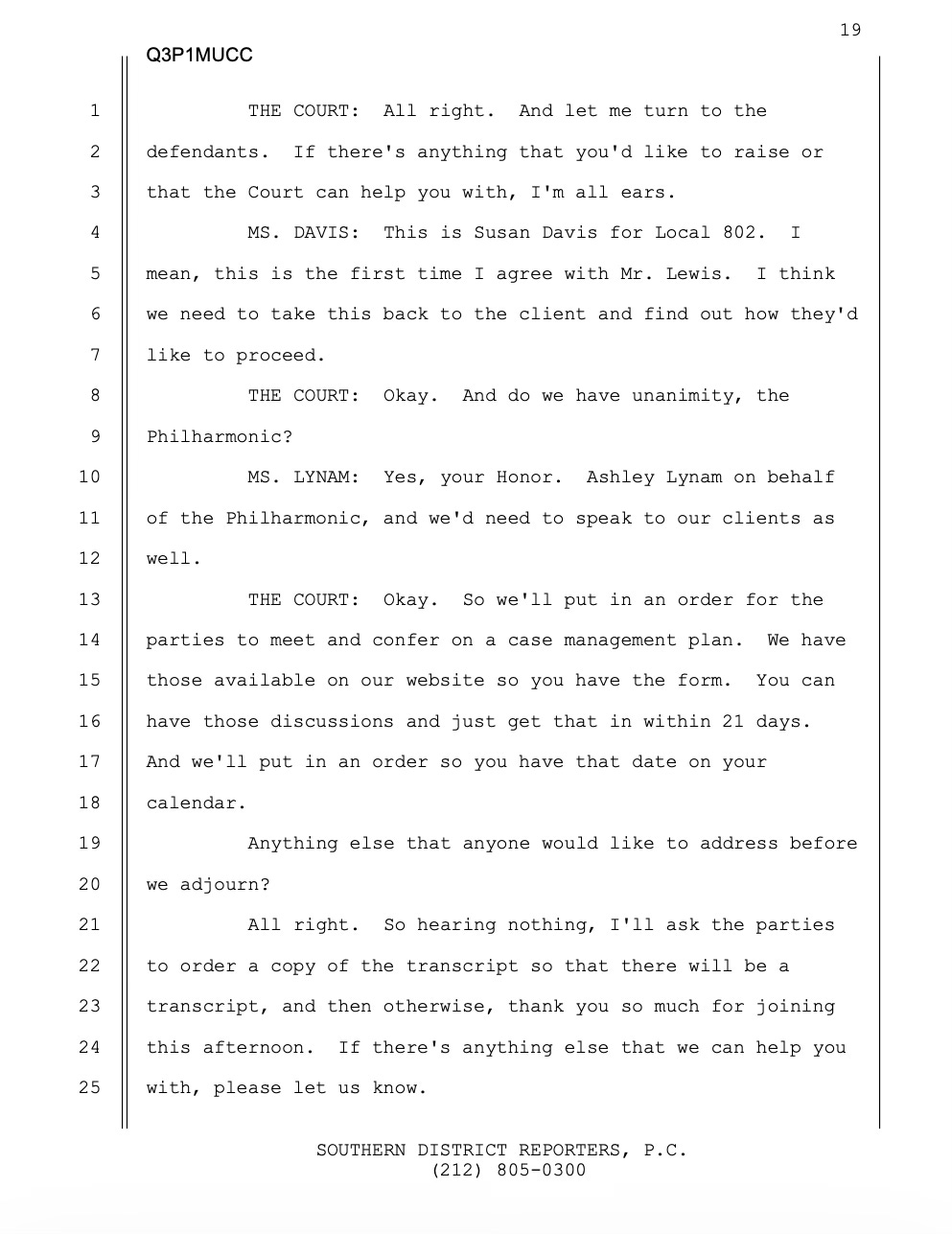
The full transcript is below.
Thank you for staying on this and keeping the information flowing. The more information and transparency there is, the less likely it is people can spin their own versions of what is going on.
Many thanks for these clarifications.