
WHEN THE CRAZY STUFF
is actually totally right and fine

This week, I’m playing four pieces, but two of them are new to me, which is pretty unusual. One each of those new-to-me works is by a dead woman and man composer.
Kaija Saariaho and her Winter Sky (Ciel d’Hiver) is one of the new works. Saariaho was the second woman to ever have an opera performed at the Met. And it took 113 years for Saariaho to appear with that second opera. (The first was Der Wald by Ethel Smyth in 1903.)
Saariaho is pretty recently dead, but I think it’s worth noting for a couple reasons that I am playing a new-to-me work by a dead woman this week. So many of us in classical music adore saying that all the greats of music history are men, and all the music worth agonizing over and studying hard is by men. If you don’t think you adore saying that, please look closely. And if you still don’t believe me, just go look at an orchestral audition repertoire list or book of excerpts compiled and annotated by Name-Your-Favorite-BFM.
Another big plus of ignoring dead women and their musical history is that we can parade them around as living composers of short opening works and talk about how much better we are doing than previous generations. Things are getting better, albeit not fast enough, we can say with a glint in our eyes! We can really take advantage of these living women in glossy brochures and interviews, and give them awards sometimes even. (If you think no one notices this approach, you might be right.)
I want to talk about a moment in this Winter Sky. I was preparing it in advance (we are obligated to show up knowing what we are doing to be employed as musicians) by studying the score. I saw this and started to shiver like I myself was barefooted in the Arctic. I imagined the conductor making the clarinetist and me play this alone on our own in front of everyone.
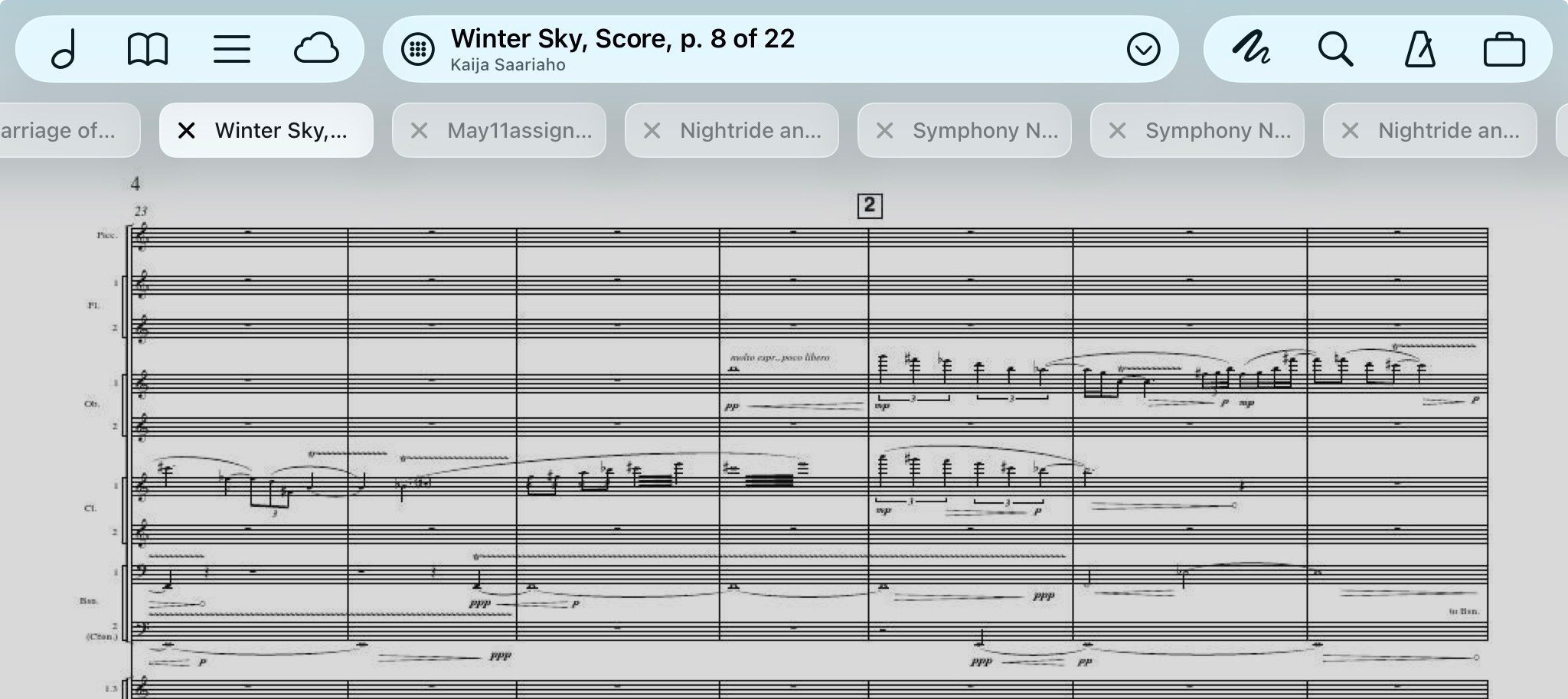
See those notes at Figure 2? That high G on oboe/high A on clarinet are notes they teach you to avoid in orchestration class. Those are notes that pop up red in music notation programs. Even I (who am happy to write red notes) thought that this shit in unison was going to be awful. Especially as an exposed solo.
I asked my colleague to touch it with me before rehearsal. It seemed fine, actually.
And somehow, the first time through with the orchestra, it was also totally fine. And then we had to wait a ton of time while the conductor talked and rehearsed other things and we got all cold. And the second time through, it was also fine.
In fact, now that I am not scared of it, I’m excited by it. I’ve never had to do anything like this before. This is not the Schubert Unfinished Symphony, starting with that clarinet/oboe unison. It’s a completely different sort of thing.
It makes me wonder about our history and the excuses we make for it. Who writes your instruction manuals and inspirational material? Usually it’s men and men. How did Saariaho know to write this, and how did she know it would be fine? That’s something I actually want to read in a book.
So, I don’t get to rehearse this one again until the dress rehearsal tomorrow. Tonight is my birthday celebration (my birthday eve, actually), and a bunch of people and I are going to watch Dear Lara. (You can still come!) It might give you a different sort of insight into the history of women in music.
Saariaho is also the first woman to have had two operas performed at the Met, when "Innocence" got there in April. I am hoping that Gabriela Lena Frank and Missy Mazzoli, both of whom have operas there this year, will have second, third, fourth operas at the Met.
Happy birthday!